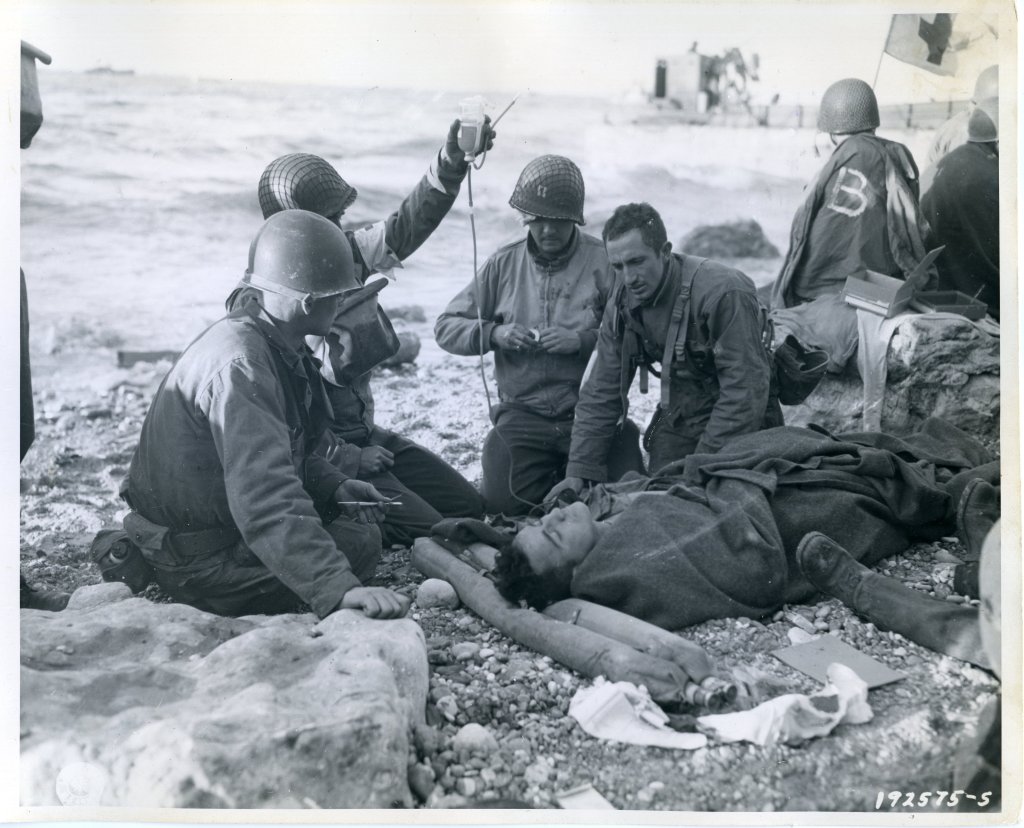
Hemorrhage is the leading cause of death in traumatically injured patients, and blood transfusion is a critical component of treatment of these patients (the other major component is stopping the bleed). The concept of blood transfusion had been theorized since at least the 17th century, but it wasn’t clinically used until World War I.
A confluence of issues came together to support the development of blood transfusions, including blood typing (Drs. Rous and Turner), refrigeration, anticoagulant use with sodium citrate (Drs. Hustin and Agote), and a massive need for its use during World War I. Canadian Doctor Lawrence Bruce Robertson serving with the Royal Army Medical Corps first performed a transfusion in 1915, and development of blood banks and storage was established in preparation for future battles starting ~1917.
Post war, transfusions and blood banking slowly became used in the civilian healthcare system (including coining the term “Blood Bank” by Bernard Fantus at Cook County Hospital in Chicago in 1937).
In 1940, blood fractionation (or separating blood into separate components) was developed. This allowed for advanced storage of the individual components – including 42 days for Packed Red Blood Cells (PRBCs), and theoretically years for freeze dried plasma (FDP). The use of individual components became the dominant transfusion technique during World War 2, and was the dominant method of transfusion post-war in the developed world in civilian medicine.
When transfusing the individual components of blood (so-called component therapy), estimates are made for the ideal ratio – particularly for traumatically injured patients with significant hemorrhage. Over the last 20 years or so, increased research has been focused on using whole blood rather than component therapy for trauma.
Reviewing the bulk of literature of outcomes with whole blood transfusion is perhaps to lengthy for this discussion, but it’s worth mentioning a few papers from the last 12 months. Lammers et al1 retrospectively demonstrated a decreased 4 hour and 24 hour mortality and decreased transfusion requirement when using whole blood vs component therapy. Morgan et al2 demonstrated via a meta analysis improved outcomes at both 24 hours and 28 days with whole blood vs component therapy. Torres et al3 retrospectively demonstrated improved outcomes specifically with early transfusion of whole blood when given within 1 hour of ED presentation for patients with severe hemorrhage.
Whole blood has been used recently in both special operations forces and conventional forces, in U.S. and foreign partners, and across the world in various civilian healthcare systems.
Future major challenges for Whole Blood use include storage and transportation, amongst others. Access to whole blood products should be a priority across military operations worldwide, including in distributed maritime operations. Previous studies have investigated enhancing shared blood banking4, and increased acquisition and storage is a priority of allied partners around the world5. In field blood donation and transfusion has been developed using the “Valkyrie” program, including recent bilateral training exercises with the Australian Defense Force and the U.S. Navy6. Familiarity with whole blood and increased research should help enhance this capability in the near future.
- https://tsaco.bmj.com/content/tsaco/9/1/e001358.full.pdf ↩︎
- https://journals.lww.com/ccmjournal/_layouts/15/oaks.journals/downloadpdf.aspx?an=00003246-202407000-00030&casa_token=htvIQaqVb0IAAAAA:Fpo2MQVneZsxx8RuTNFqCFl5PQ6MKtHApD0pCEmm14hEaN9j2Jke1sqMLzS74jALKpuNKDbcTj_8A1CqtsXnposxTfmP ↩︎
- https://emergencymed.org.il/wp-content/uploads/2024/02/TimingtoFirstWholeBloodTransfusionandSurvival-FollowingSevereHemorrhageinTraumaPatientsTimingtoFirstWholeBloodTransfusionandSurvival-FollowingSevereHemorrhageinTraumaPatients.pdf ↩︎
- https://militaryhealth.bmj.com/content/early/2023/09/14/military-2023-002516.abstract ↩︎
- https://www.japantimes.co.jp/news/2024/02/11/japan/defense-ministry-blood-products/#:~:text=The%20Japanese%20Defense%20Ministry%20plans%20to%20produce,stop%20bleeding%2C%20ministry%20officials%20told%20Jiji%20Press. ↩︎
- https://www.navy.mil/Press-Office/News-Stories/Article/3788360/us-navy-adf-participate-in-valkyrie-emergency-fresh-whole-blood-transfusion-tra/ ↩︎

 Scalpels & Strategy
Leave a comment